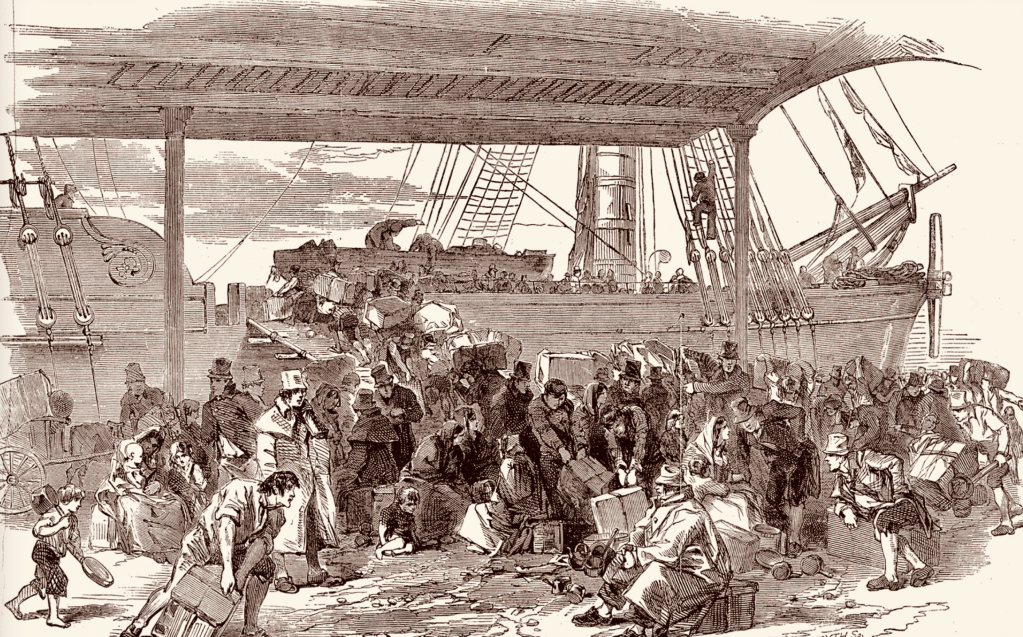
“Surplus People.” A chilling label applied to Ireland’s poor peasantry in the mid-19th century, their numbers in the millions, during the years of the Great Hunger, a.k.a. the Famine, a.k.a. An Gorta Mór.
In several centuries past, England colonized Ireland after a hostile takeover. The Anglo-Irish landlords were the recipients of the stolen land, and they, in turn, leased it to the very people they had stolen it from, making them their tenants who now paid rent to them. Penal Laws were enacted to keep the Irish in subjection. They prohibited Catholics, the faith of the overwhelming majority of the Irish people, from owning land, holding public office, and even educating their children. They were forbidden to practice their faith and faced severe consequences for noncompliance, including fines, imprisonment, or even banishment from Ireland. Though some of these Penal Laws had relaxed or were eliminated by the eve of An Gorta Mór.
An Gorta Mór snatched the lives of countless millions, and millions more fled Ireland, ultimately halving the island’s population. Instead of providing healthy food, helpful resources, or any other truly beneficial scheme to assist desperate people, the British government and the Anglo-Irish landlords basically blamed the people for their own misery and suffering (today we refer to this kind of manipulative tactic as “gaslighting” and “projection”), and they orchestrated propaganda campaigns, including by posting up flyers and placing advertisements in the newspapers, encouraging voluntary emigration. This rhetoric stated that their departure from Ireland, the island home they’ve inhabited for many thousands of years, would serve their best interests.
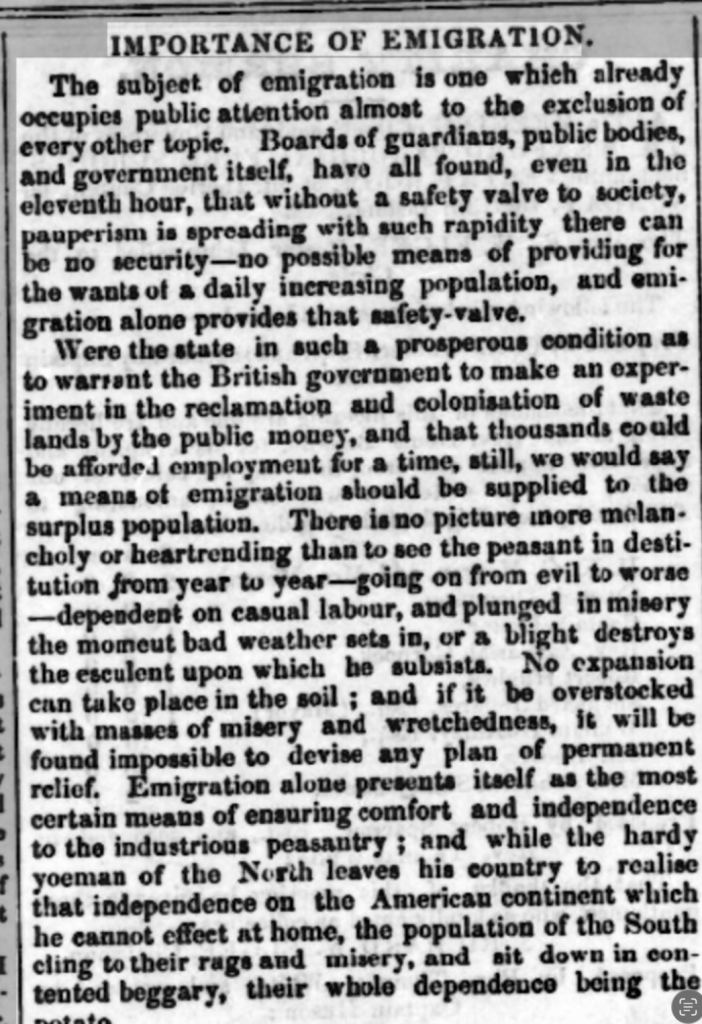
Wexford Independent Newspaper. FMP
The historical irony of this horrific situation cuts deep. Perhaps, yes, this was a necessary evil in a highly complex problem; however, the government authorities and landlords had, at the same time, determined that it would be far more profitable for them to raise grazing animals, like sheep, on their properties, which require minimal maintenance, than to support tenant farmers and laborers. At the same time, in Irish ports, ships were loaded up with a variety of food for export to England, including sheep. This export business actually increased during these awful years. Indeed, leaving Ireland proved beneficial for people, though perhaps not in the way the people in power had imagined. Ireland’s demographic transformation following An Gorta Mór, through the mass exodus and then via a steady stream of emigration, ultimately contributed to Ireland’s long struggle towards Freedom. It was greatly achieved in 1922, in the formation of the Republic of Ireland. Yet even today, the island of Ireland remains divided. Ireland, an island roughly the geographical size of the State of Maine in the United States, continues to have a portion of its land held under English colonial rule. This part of Ireland is known today as Northern Ireland. It is a complicated story and a sensitive topic. And this partition is staunchly supported by some people to this day.
This history reminds us of uncomfortable questions, and the questions seem appropriate even for our time:
Are we, the people, gullible and so easily led?
Do we love our shackles?
The outcome of this Irish experience suggests that the propaganda worked. This tactic was not carried out by brute force but rather by manipulating the minds of desperate people, convincing them that emigration was in their best interest. All the people had to do was look around them. Oh, the despair. So, like a domino effect, it worked. Once some people got on board with it, it seemed that it was much easier to get others on board. Those already abroad would encourage others to do the same. The people who held a belief in a “surplus population” successfully persuaded those deemed as surplus to voluntarily depart their homeland, the home and lands their ancestors inhabited for many thousands of years.
Yet this is only one aspect of a complex situation. To my point, though, it demonstrates that even successful mind-bending manipulation, in this case by influential and powerful people and governments, can and does produce unintended consequences. In the example of what happened during An Gorta Mór, the tide of emigration was followed by great fanaticism grown out of generations of chronic societal abuse trauma, a complex post-traumatic stress disorder, of those at home and in the diaspora, where some were becoming financially successful and organizers of charities and liberation campaigns. Though there existed a vast ocean between them, a powerful, uniformed resistance emerged, including the Fenian movement of the 1860s, the Land League revolutionaries in the latter 19th century, the UIL, and others, leading up to the 1922 Liberation Day in Ireland. Freedom!
So it seems Ireland’s Freedom was realized in part as an unintended consequence of that propaganda espoused by the British government and their landlords. Freedom, yes, from one of the most devastating of human circumstances, An Gorta Mór, and from centuries of unbearable abuse, marginalization, and oppression, and the generational trauma that emerged from it. And, some argue the trauma persists to this day, that it altered and it lives within our DNA, more than a century and a half later.
The questions I’ve posed in this post, I feel, are incredibly relevant as we navigate our own information landscapes and power structures in current times.
“People love their shackles.” ~ John Fowles
“It is difficult to free people from the chains they revere.” ~ Voltaire.
I don’t know all of the facts and nuances of Ireland’s history or its ongoing story. I don’t even live there. However, I do feel that I know enough to ask questions about what I have learned. And to ask how certain behaviors, decisions, and events back then may relate to those occurring now.
Oh, before closing this out, I have one more bit to share. Ireland, more than a century and a half later, still hasn’t recovered from the population loss of An Gorta Mór.
Thank you for reading.
♥︎ Krista
——————
——————
Further Reading:
Donnelly Jr., James S.. The Great Irish Potato Famine. Sutton Publishing, 2001.
Foster, R. F.. Modern Ireland, 1600–1972. London: Penguin Books, 1988.
Gray, Peter. “Ideology and the Famine,” in The Great Irish Famine. Mercier Press, 1995.
Hennessey, Thomas. A History of Northern Ireland, 1920–1996. Gill & Macmillan, 1997.
Miller, Kirby. Emigrants and Exiles, Ireland and the Irish Exodus to North America. Oxford University Press, 1985.
Mulvihill, Jerry. The Truth Behind The Irish Famine, 1845-1852. Jerry Mulvihill, 2021.
Ó Gráda, Cormac. The Great Irish Famine. Cambridge University Press, 1989.
Image source:
“Importance of Emigration,” Wexford Independent Newspaper.” Findmypast.com. Findmypast.com. last accessed January 10, 2026. https://tinyurl.com/2p85eak2

 Krista Luttrell
Leave a comment