• Iron Roads and Irish Labor: Building Maine’s Railroad, Part II

    In the last story web post, Iron Roads and Irish Labor: Building Maine’s Railroad, I shared information about some of the accidents and deaths of Irish immigrant laborers who built Maine’s growing railroad system. This story adds to it by following the lives of some other men who labored on Maine’s Atlantic and St. Lawrence Railroad. Their stories are of exploitation and longing, and of their will to persevere in the face of hardship.

    In the mid-1840s, the Atlantic and St. Lawrence Railroad began its push through the forested hills of western Maine, laying down the miles and miles of iron roads that would connect Portland to Montreal. This ambitious project was but one of many railroad developments occurring in America at the time.1 Yet for the countless thousands of Irish immigrant men who helped build America’s railroad infrastructure, the experience was often marked by hardship, injustice, and tragedy.

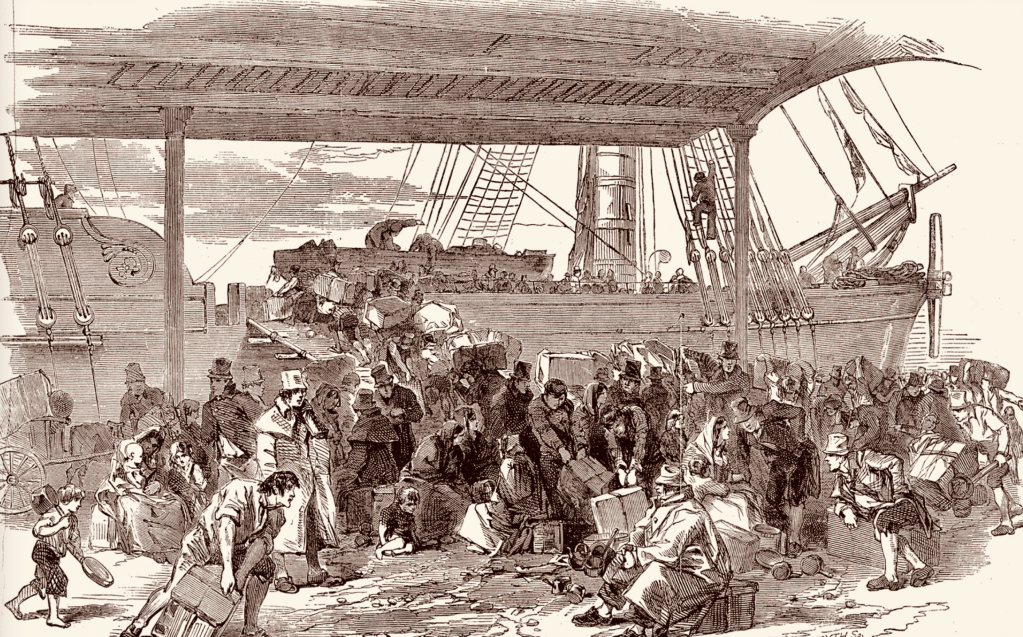
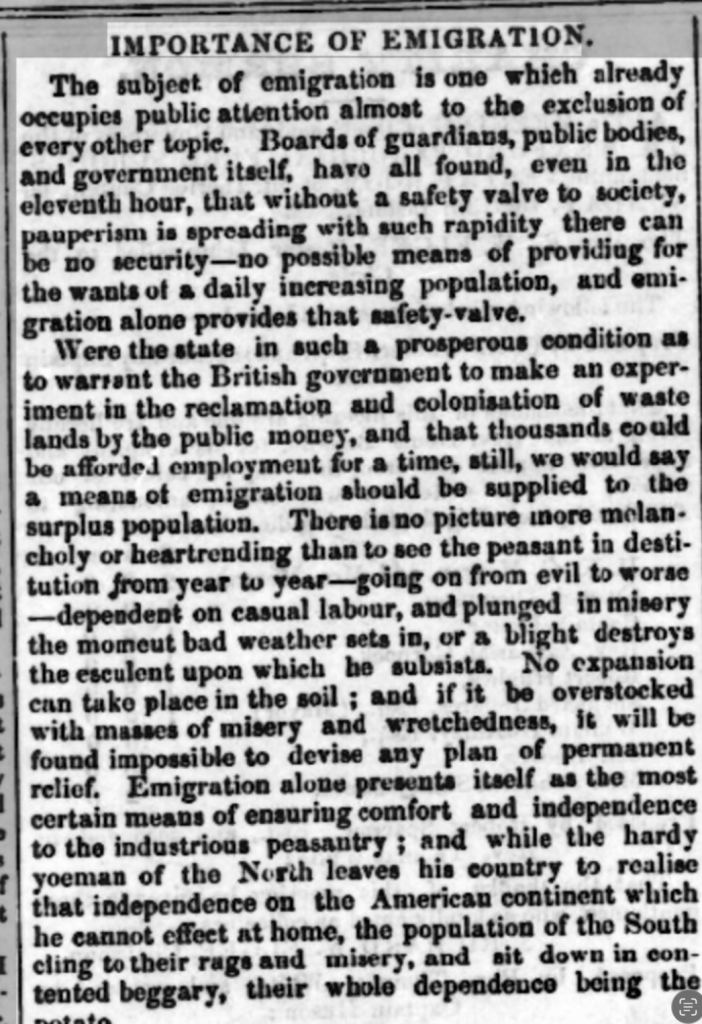
    The timing of construction could not have been more opportune. Across the Atlantic, Ireland was gripped by the Great Hunger. Between 1845 and 1852, famine and disease devastated the island, forcing millions of people to emigrate. 2 Many sought refuge and work in America, where they contributed to the country’s impressive transportation infrastructure boom by digging canals, building granite rail bridges, and laying down the iron rail tracks.

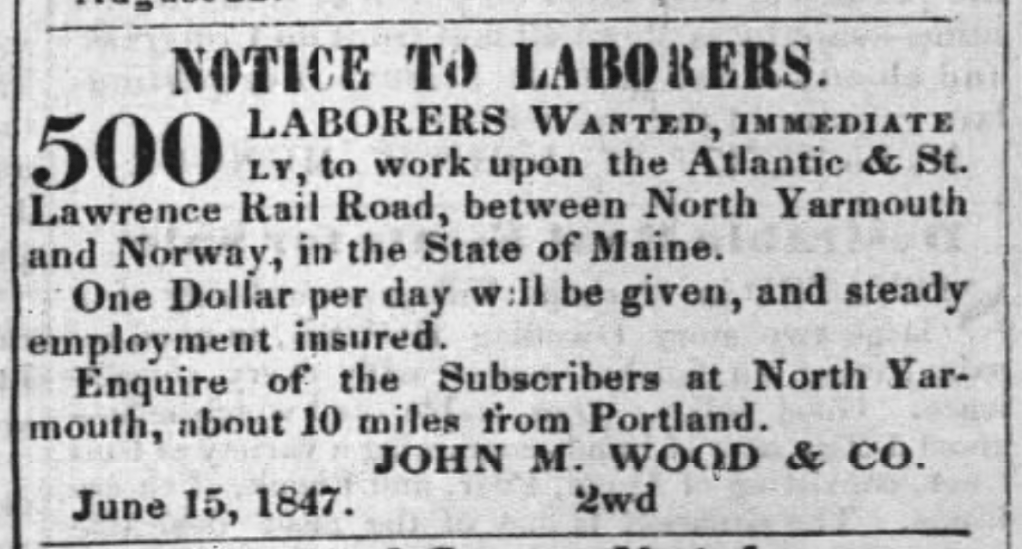
    Railroad companies needed workers. Prominent businessmen and contractors, such as John M. Wood, placed newspaper advertisements seeking to recruit 500 to 1,000 laborers at a time with the promise of a dollar a day to work on the railroad. The destitute and unskilled Irish immigrants, fresh off the boat from a starving homeland, eagerly took up the offer. But the promise was not all that it had seemed. Laborers’ wages were sometimes withheld or delayed. Laborers on the Atlantic and St Lawrence Railroad jobs would soon learn they would receive only 75 cents a day, a quarter less than promised. The workers lived in makeshift shanties at the job sites, exposed to illness and harsh weather, including rain, snow, and freezing temperatures. At this time, it was a bit cooler than it is today because the northern hemisphere was still emerging from a mini ice age! In the winter months, temperatures plunged, and snow piled up to several feet deep. 3 Laborers endured hazardous work conditions where accidents and fatalities were the norm, including from falling rocks and collapsing embankments.

    The contractors overseeing the early sections of the Atlantic and St. Lawrence line, “John G. Mires” and “Mager Hall,” became known for their exploitation. A news report published in the Boston Pilot on May 15, 1847, under the title “Injustice to Laborers,” exposed their abuse, stating that these businessmen “seduced and enticed a great number of Irishmen from the city of New York to come out here at a dollar a day, and at the end of the month, to deduct $7.33 from their miserable wages.” When the Maine Irish immigrant railroad laborers demanded the pay they were owed, contractors threatened to replace them with “three hundred starving Irish now landing in New York and Boston, that would be glad to get their grub.”4

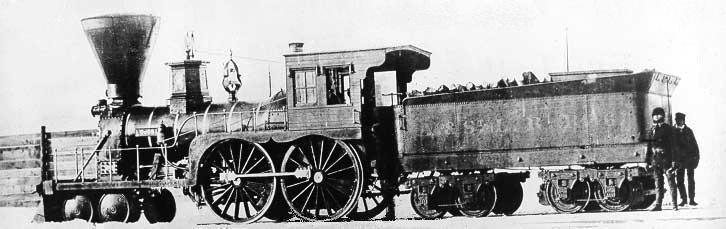
    “Coos,” built in 1850 by The Portland Company, on the route of the Atlantic & St. Lawrence Railroad, Wikipedia.

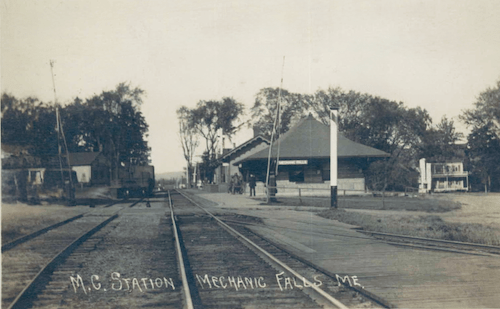
    Yet even amid such injustice, these men kept working, and they sought to build a sense of community. Some Irish immigrant men employed on the Atlantic and St. Lawrence Railroad placed “Information Wanted” advertisements in the Boston Pilot, a Boston, Massachusetts-based newspaper, seeking their lost relatives who had also crossed the Atlantic. These notices spoke of loneliness and longing, but also the belief that their family ties could make a difference in their daily lives, in this strange, new world. Brothers James and Peter Mulvy, who were at the Mechanic Falls, Maine, railroad site, were in search of their brother, Michael.5 Their advertisement was published on May 5, 1849. Michael Donnelly, working on the Danville, Maine, section of the railroad, placed an ad on April 22, 1848, seeking his brother, Thomas, whom he had last seen in Pictou, Nova Scotia. The Donnelly brothers had emigrated from the townland of Ballyfeeny, in Brumlin, County Roscommon, Ireland.6 Their pleas for news of family reflect the experiences of countless others whose journeys scattered kin across the continent and the longing for closeness.

    This story offers further examples of the Irish immigrant railroad laborer experience in mid-19th-century Maine and elsewhere in America. They arrived in this new land with little to nothing, and they were often met with exploitation and hardship. So, let us remember their contributions and sacrifices that helped lay the foundations of communities, industries, and connections that endure in America to this day. The rails they built in this great country were their pathway toward a better life than what was left behind in the old country. The iron roads were built with a spirit that refused to let hardship have the final say in their lives.

    Thank you for reading this story.

    ♥︎ Krista

    – – – – – – – – –

    Notes

    1. Kenny, Bill. A History of Maine Railroads. History Press, 2020. 66-68. ↩︎
    2. Miller, Kerby A, Emigrants and Exiles: Ireland and the Irish Exodus to North America. Oxford University Press, 1985. ↩︎
    3. Smith College. “The Effects of the Little Ice Age.” Accessed October 26, 2025. https://www.science.smith.edu/climatelit/the-effects-of-the-little-ice-age. ↩︎
    4. “Injustice to Laborers.” Boston Pilot. May 15, 1847. Vol. 10, no. 20. Accessed June 11, 2025. https://newspapers.bc.edu/?a=d&d=bpilott18470515-01.2.21&srpos=1&e=——-en-20–1–txt-txIN-%22Injustice+to+laborers%22—— ↩︎
    5. “Information Wanted: Of Michael Mulvy.” Boston Pilot, May 5, 1849, vol. 12, no. 18. Accessed October 20, 2025. https://newspapers.bc.edu/?a=d&d=bpilott18490505-01.2.17.3&srpos=4&e=——184-en-20–1–txt-txIN-mechanic+falls——. ↩︎
    6. “Information Wanted: Of Thomas Donnelly.” Boston Pilot, April 22, 1848. Vol. XI, no. 17. Accessed October 20, 2025. https://newspapers.bc.edu/?a=d&d=bpilott18480422-01.2.14.4&srpos=5&e=——-en-20–1–txt-txIN-Michael+donnelly%2C+pictou——. ↩︎

  • Art: Yellow Tulips

    Painting on small tile-sized composite boards is fun. A painting project can be done relatively quick, perhaps in less than an hour or two. Once dried, it can be hung, framed, or unframed, in smaller spaces, such as over a desk, beside a kitchen window, or on any narrow wall, making them perfect for adding a personal touch. Little art makes a special gift, too.

    “Yellow Tulips” KL
    5’x5′ oil paint on composite board

    ♥︎ Krista

  • Iron Roads and Irish Labor: Building Maine’s Railway

    In the 1840s, echoes of a new sound emerged from Maine’s forests: the rhythmic bang of hammers and picks striking upon granite and iron. Within a few years, the promise of progress had reached the northernmost corner of Maine and other northern New England States. Portland’s merchants dreamed of an economic lifeline tethering their city to the Canadian interior, a rail artery stretching from their Atlantic port to Montreal. Out of that ambition came the Atlantic and St. Lawrence Railroad, a venture that would carve through forests, mountains, crossing rivers, and, most enduringly, be made in the blood and sweat of immigrant labor.

    When construction began in 1846, Maine’s labor market was unprepared for the scale of the task at hand. Local men, including farmers and tradesmen, were seemingly unwilling to endure the brutal, backbreaking manual labor required by the work. The company’s leaders, however, quickly identified where to look to fill the much-needed labor force.

    Across the Atlantic, the tragedy of the Great Hunger (An Gorta Mór) was unfolding. Beginning in 1845, a devastating potato disease swept through Ireland, destroying the staple food crop for the vast majority of the people. Governmental response was delayed, inefficient, and substandard, thereby intensifying the people’s suffering and deaths. Over one million people died of starvation and disease, and millions more were forced to flee their country to survive.1 The Atlantic and St. Lawrence Railroad actively capitalized on this desperation. Ships arrived in ports like Boston and Portland carrying the poor, half-starved, and weakened masses of Irish souls escaping the calamity in their homeland.

    “Notice to Laborers” Portland Press Herald (Portland, Maine), Friday, June 25, 1847, p. 3. Link

    Old newspapers, including ones published in Ireland, carried recruitment advertisements, calling for hundreds of laborers to work on the railroad. For those advertisements in Ireland’s papers, a promise of a dollar a day and sponsored ship passage in exchange for a year’s employment commitment was enticing. Destitute, desperate, and determined, Irishmen answered this call, picking up the shovels and picks to earn a meager wage and with a dream of a better life in a new land. The terms of their employment were exploitative. Irish immigrants dug, blasted, and pushed their way northward from Portland to Montreal. The average daily wage for this dangerous labor was often less than a dollar, with most rates falling between 75 and 90 cents. Company deductions for the cost of food, clothing, and rudimentary lodging in company-owned shanties may have further reduced their meager compensation. The work was considered so dangerous that a grim saying about railroad construction emerged, something to the effect of: “There’s an Irishman buried under every railroad tie.”

    The laborers cut deep into Maine’s forests, granite hills and ridges, and bridged the rivers. Diseases, such as cholera, spread easily in their work camps, where sanitation was minimal or nonexistent. Accidents, however, were the most immediate and looming threat. Black powder explosions were unpredictable; a single mis-timed fuse or loose stone sent deadly fragments flying and in unexpected directions, maiming or killing workers. Workers fell from or were smothered by collapsing embankments. They were crushed by the cars and by the wagons hauling loads and fill. They sometimes lost a leg, an arm, fingers, a foot, or their eyesight. The human cost of this “progress” may never be fully understood, as records of accidents and fatalities are scant. Company records and local newspapers rarely included the names of the dead and injured. Irish laborers’ families may have received no official notice of their fate. The danger was not confined to the remote wilderness; tragedy struck within the city of Portland, too, demonstrating that the constant, lethal peril faced by these workers was real and it was everywhere.

    Here is a small list of accidents and deaths and their locations, as mentioned in local newspapers, to illustrate the dangers faced by Irish railroad laborers, named and unnamed, working in the state of Maine:

    • Bath: In 1849, Thomas Caron, an Irish railroad laborer, was run over by a gravel train. 2
    • Bethel: In 1851, an Irish railroad laborer slipped off a gravel train, jamming both of his legs, killing him.3
    • Cumberland: On August 25th, 1850, a railroad incident killed several laborers and mangled several more.4 While the news account did not provide their identities or ethnicities, a quick search for city and state death records for the accident date, which includes a cause of death as a casualty, produced names of three possible victims: Matthew Haley5, Jeremiah O’Brien6, and Jerry Breslin7.
    • Danville: In 1847, Patrick Conley, an Irish railroad laborer, froze to death.8 In 1847, Patrick Masterson, an Irish railroad laborer, was killed by the collapse of an earthen embankment.9
    • Falmouth: In 1847, John Barrett, an Irish railroad laborer, was killed almost instantly in an accident at the railroad bridge on the Presumpscot River.10
    • Gardiner: In 1850, James Cahill, an Irish railroad laborer, was killed by the collapse of an earthen embankment.11
    • Gorham: In 1852, Patrick Ryan, an Irish railroad laborer, fell off the top of a moving train, falling onto the rails, and then the train ran over his leg, killing him.12
    • Orono: 1853, Timothy Crowley, 28, killed instantly by the collapse of an earthen embankment while working on the railroad.13
    • Paris: In 1850, Thomas Foley, an Irish railroad laborer, died as a result of blasting rock about eight miles above the town.14
    • Portland: In 1847, some Irishmen excavating dirt on the city’s railroad track were injured. One, named Smith, broke several ribs.15 In 1847, Patrick Tumy, an Irish railroad laborer, broke his leg while loading stone on a wagon.16 In 1853, an Irish railroad laborer was killed by being jammed between two gravel cars.17

    By the end of 1853, the Atlantic and St. Lawrence Railroad line was complete, and it eventually became part of the Grand Trunk Railway system. The line connected Portland to Montreal, creating a vital link between New England’s seaports and Canada’s trade routes, transforming Portland into a bustling port city and driving even more economic growth across industries that benefited from or supported this new line.

    Yet thousands of Irish laborers who built the tracks are nameless, and some of those whose names were recorded, such as in the 1850 Maine US census, seemingly vanished. Their sacrifices, found in their broken bodies, lost lives, and shattered families, were rarely recorded with the same care as the company’s accomplishments and its profits. Some of the surviving laborers may have moved on to other railroad sites, while others may have secured different employment, such as in the mills. In some cases, laborers who were permanently disabled by their injuries were unable to work, leaving them financially dependent on their families or friends, or they might have ended up in the city’s almshouse. Few of their identities were preserved; fewer still remembered. But remnants of their hard work, the iron rail bridges and their stone foundations, and the miles and miles of rail track still stretching along the old route to Canada, endure as a testament to their existence and the incredible sacrifices they made to tie our two countries and economies together.

    Do you have an Irish immigrant ancestor who helped build the Maine railroad system in the mid-19th century? Do share their story in a comment, or send a pm.

    Thank you for reading this story.

    ♥︎ Krista

    – – – – – – – – – – – – – – – – – – – – – – – – –

    Notes

    1. Miller, Kerby A, Emigrants and Exiles: Ireland and the Irish Exodus to North America. Oxford University Press, 1985. ↩︎
    2. “Railroad Accident” Portland Press Herald (Portland, Me), Mon, July 16, 1849. ↩︎
    3. “Portland, 7th” The Weekly Mercury (Bangor, Me), Tue, October 14, 1851. ↩︎
    4. “Shocking Railroad Accident” Portland Press Herald (Portland, Me), Mon, August 26, 1850. ↩︎
    5. “Maine, U.S., Death Records, 1761-1922,” death certificate for Matthew Haley, August 25, 1850, Cumberland County, Maine, Maine State Archives, Augusta; digital image, Ancestry.com, https://www.ancestry.com (accessed July 2, 2025). ↩︎
    6. Maine, U.S., Death Records, 1761–1922,” entry for Jeremiah O’Brien, died August 25, 1850, Cumberland County, Maine; Ancestry.com (www.ancestry.com : accessed July 2, 2025). ↩︎
    7. Maine, U.S., Death Records, 1761–1922,” entry for Jeremiah O’Brien, died August 25, 1850, Cumberland County, Maine; Ancestry.com (www.ancestry.com: accessed July 2, 2025). ↩︎
    8. “Froze to Death” Portland Press Herald (Portland, Me), Thur, February 25, 1847. ↩︎
    9. “Fatal Accident” Portland Press Herald (Portland, Me), Tue, February 16, 1847. ↩︎
    10. “Fatal Accident” Portland Press Herald (Portland, Me), Sat, December 18, 1847. ↩︎
    11. “Fatal Accident” Portland, Press Herald (Portland, Me), Fri, February 8, 1850. ↩︎
    12. “Accident” Portland Press Herald (Portland, Me), Fri, December 24, 1852. ↩︎
    13. “Fatal” Portland Press Herald (Portland, Me), Mon, March 14, 1853. ↩︎
    14. “Accidental Death” Portland Press Herald (Portland, Me), Sat, August 10, 1850. ↩︎
    15. “Accident” Portland Press Herald (Portland, Me), Thur, February 11, 1847. ↩︎
    16. “Accident” Portland Press Herald (Portland, Me), Thur, July 8, 1847. ↩︎
    17. “Accident” Portland Press Herald (Portland, Me), Tue, November 29, 1853. ↩︎

  • Are Your Ancestors For Sale on eBay?

    Every day on marketplace websites like eBay, Etsy, Craigslist, and Facebook, fragments of family history quietly change hands. Among them are old photographs, personal letters, postcards, diaries, scrapbooks, school yearbooks, and much more. These items, once much cherished by a deceased relative, are sold off to strangers. How do these family treasures end up on the online marketplace? Too often, when an older relative passes away, surviving family members may be left feeling overwhelmed by the task of going through the deceased’s lifelong accumulation of “things.” These ‘things’ were stuffed into boxes, cabinets, and drawers, and surviving relatives, without the resources of assistance, energy, time, or willingness to sort through them, offload them at a yard or estate sale, or simply toss them in a recycling or trash bin. A wedding photo or diary that could have told stories of one’s great-grandparents’ lives may instead end up in a stranger’s hand and then sold for a few dollars to another stranger.

    These objects are so much more than musty old stuff; they are family memory keepers. Every faded photograph and handwritten letter tells a unique story, and they are viable links to unlocking the lives and relationships that help to shape a family’s present. Pause and make the effort to go through great grandma’s boxes, no matter how overwhelming it seems or how long it may take. The effort can mean rescuing irreplaceable parts of a family’s history before they are lost forever. And, if you do not want to take on the task, offer it to another family member who does.

    Frances Craven, the pretty young woman in the above photograph1, was born in 1888 in Portland, Maine, to Irish immigrants, Patrick Craven of Annaghdown, County Galway, and Margaret Colleran, of Donaghpatrick, County Galway. Her parents married at St. Dominic’s Church in Portland in 18742, and, according to information provided in the 1900 U.S. census3, the couple had eight of twelve surviving children, including Frances, then called Bridget. She went on to marry a man named William Harvey, and they had a son, William, Jr., who, too, married and 4had children. This bit of information suggests Frances likely has living relatives. Are you one? If so, and as of today’s date, her photograph is selling on eBay for $24.75 or best offer.

    ♥︎ Krista

    – – – – – – – – – –

    Notes:

    1. eBay. “Frances Craven Harvey photo #1, eBay ID:313084315431.” Last accessed August 15, 2025. https://ebay.us/m/4MOPnx. ↩︎
    2. Ancestry.com, “Maine, U.S., Birth, Marriage and Death Records,” accessed August 2, 2025, https://www.ancestry.com. ↩︎
    3. Ancestry.com. “1900-1950 U.S. census population schedules,” Last accessed August 2, 2025. https://www.ancestry.com. ↩︎
    4. Maine, U.S. Department of Human Services. “Marriage Record for Frances Craven and William J Harvey, 6 October 1923.” Maine, U.S., Marriage Index, 1892–1996. Ancestry.com. https://www.ancestry.com/search/collections/6904/records/1110640. ↩︎

  • A Union in Motion

    On December 9th, 1850, at St. Dominic’s Church in Portland, Maine, Patrick Burke and Bridget Kildea of Paris Cape stood before Rev. John O’Donnell and made their matrimonial vows. Their witnesses, Patrick Cunningham and Catherine Burke, the wife of Thomas Gantley, Portland residents, were likely close family members.1

    Paris Cape is in Paris, Maine, and during this period was one of several newly designated train sites in the state for the Atlantic and St. Lawrence Railroad, formed just a few years prior. South Paris was and still is a small community in hilly Oxford County, located approximately a few dozen miles north of the city of Portland. At the time of the 1850 U.S. census, the enumerator recorded dozens of Irish immigrants and their families in the community. A careful examination of the surnames suggests that many, but not all, of these people hailed from County Galway, and some of them may be from the Connemara region. Alridge, Clarity, Coffee, Connolly, Curran, Faherty, Flaherty, Folan, Geritty, Griffin, Kelly, Kildea, King, Leonard, Lynch, McDonough, and Naughton 2

    The parish register entry is the only known reference to Patrick and Bridget, fixing them in a time and space: two young hearts bound together by their faith and living in a small railroad Irish immigrant enclave nestled in between the shadowy tall pines and vast farm fields of rural western Maine.

    The two are not found in the 1850 or 1860 U.S. census schedules of Paris or Portland.3 Like many Irish railroad employees and their families of this period, they may have just arrived in America, escaping the ravages of the Great Hunger (An Gorta Mor),4 or had been living just outside the enumerator’s reach. Railroad work was plenty, but it was dangerous, demanding physical labor, and transient by nature: when the grading and track-laying finished in one town, surviving crews and their families packed up their few possessions and moved on to the next job site.

    Help Wanted advertisement in the PPH, 1851

    Patrick and Bridget may have joined this migratory flow, continuing northwesterly through remote parts of the state, and then through northern New Hampshire and Vermont, as the railroad connected with Montreal in Quebec. Their story, glimpsed only in the two-line entry of the parish registry, mirrors that of countless thousands of Irish immigrants whose names appear once or twice in the records and are now buried in the pages of America’s history.

    For descendants and historical researchers alike, their marriage is more than a genealogical note. It is a reminder that behind some of the parish register entries and census lines were Irish immigrant lives in motion. Lives rolling forward on the cue of a train’s whistle and with a desperate hope for a better life in a new land.

    I hope you enjoyed this story. If you have information about an Irish immigrant ancestor who worked as a laborer for the Atlantic and St. Lawrence Railroad, Grand Trunk Railroad or The Portland Company during the mid-19th century. I’d love to learn about them.

    ♥︎ Krista

    – – – – – – – –

    Notes

    1. Parish register, St. Dominic’s Church, entry for marriage of Patrick Burke and Bridget Kildea, December 9, 1850, Diocese of Portland Archives, Portland, Maine. ↩︎
    2. “1850 United States Federal Census, Paris, Oxford County, Maine,” Ancestry.com, accessed July 5, 2025, https://www.ancestry.com. ↩︎
    3. “1860 United States Federal Census, Paris, Oxford, Maine,” Ancestry.com, accessed October 24, 2025, https://www.ancestry.com ↩︎
    4. Miller, Kerby A, Emigrants and Exiles: Ireland and the Irish Exodus to North America. Oxford University Press, 1985. ↩︎

  • A Poem: Cold War Relic


    Thirty seconds it was-
    or maybe a minute-
    on a pleasant Saturday noon,
    the blaring horn sliced
    through the pine tree air
    where we kids once swung
    higher, higher, and higher
    as if our feet could touch
    the bright blue sky
    beyond the needle green.
    My father sat and sipped
    his steaming Nescafé,
    immersed in pages of fading news,
    as that clockwork blare
    cut through our dog day,
    and snow days,
    and mud-filled days-
    a relic it was, of vigilance
    we children couldn’t grasp.
    The specter of the Cold War
    hovered
    like an odd shadow
    over our sun-filled summer play.

    ♥︎ Krista

    © 2025 Krista Luttrell

  • The Portland Company and Employee Housing

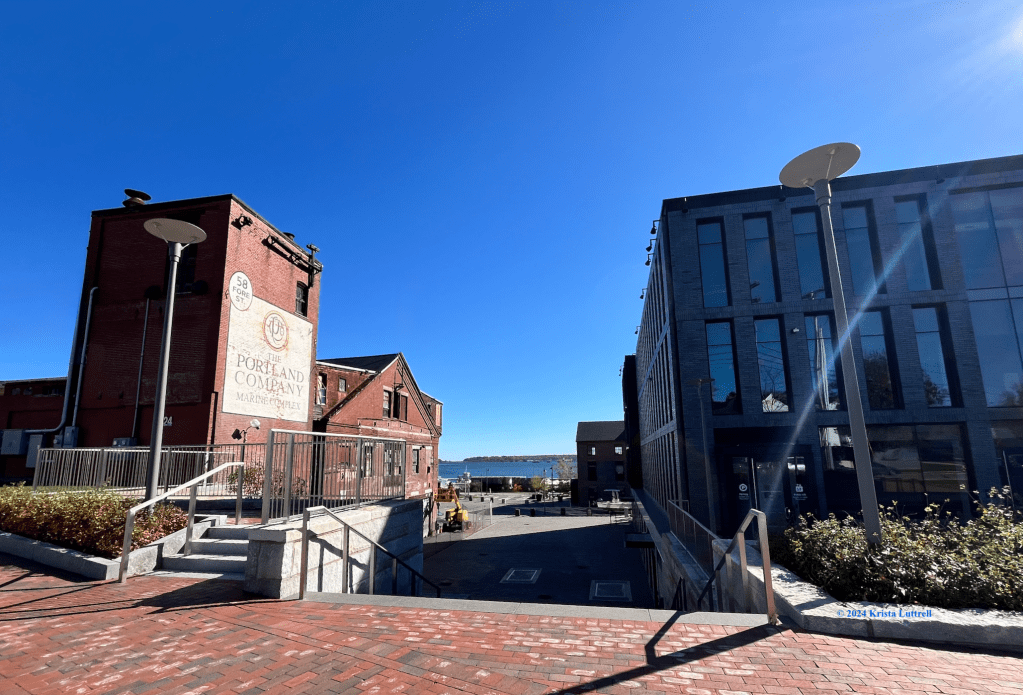
    The Portland Company was founded in 1845 by John Poor, a lawyer and entrepreneur originally from Andover, Maine. It played a pivotal role in Portland’s industrial growth during the 19th century. Situated on the waterfront side of Fore Street at the bottom of Munjoy Hill, the Company quickly became a leading manufacturing hub, producing steam engines for locomotives and ships as the rail industry expanded rapidly across the nation. By the end of 1860, it had built several steam fire engines, including the Casco, the Greyhound, and the Machigonne. The Company soon became the city’s largest employer.

    the Greyhound fire steam engine
    (clicking on image takes you to the Vintage Maine Images website)

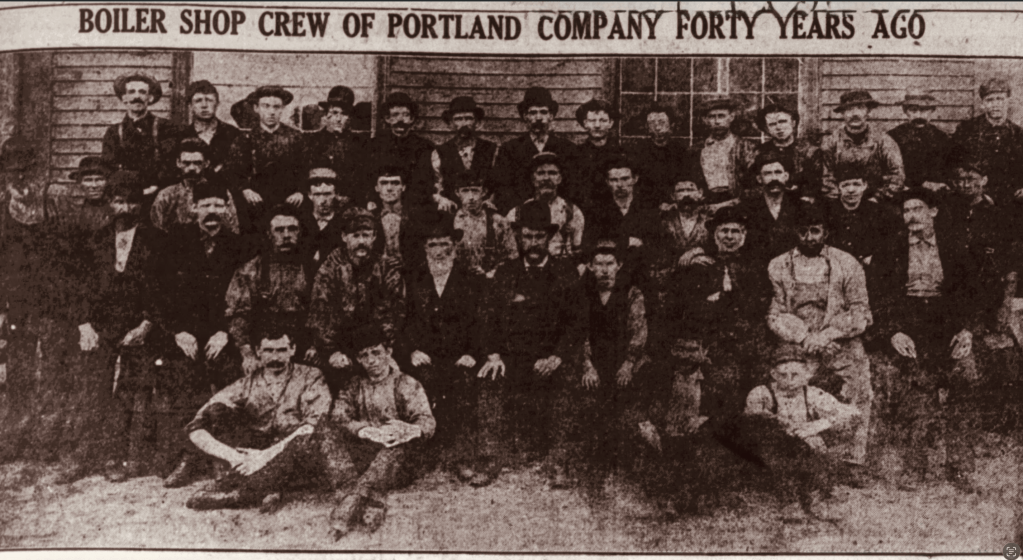
    The boom in rail transport created a constant demand for labor. To meet need, the Company relied heavily on the city’s growing population of newly arrived immigrants, and most of them were Irish. Many Irish arrived in Portland with limited resources and unskilled, but they brought determination, resilience, and a willingness to learn and work hard. They performed physically demanding labor for long hours in the Company’s machine shops, foundries, and yards.

    They sent letters with money home to their family and friends in Ireland, sharing news of steady employment opportunities. This helped fuel chain migration into the city. Before too long, Munjoy Hill and surrounding neighborhoods swelled with Irish immigrants and their growing families.

    A research discovery demonstrates one option that immigrants like the Irish could take to improve their situation: the Company appears to have offered homeownership opportunities. On December 11th, 1860, five Irishmen-Michael J. Burke (an ancestor of this author), Patrick Arnold, James McMahon, and William and Patrick Parks-purchased residential lots along Adams Street, just one block from their job. The land had been surveyed only two months earlier by George Sherwood. Their property acquisitions represented forward progress in their family’s stability and economic security in America.

    17 Adams Street, Portland, Maine. 1924

    A bit about the property recipients: Michael J. Burke, laborer and boilermaker from Annaghdown, County Galway. He purchased a lot at 17 Adams Street for $240 and built a two-family home. The remaining purchasers were Patrick Arnold, a blacksmith from County Cork; James McMahon, a laborer from County Tyrone; and Patrick and William Parks, laborers from County Donegal.

    These modest land transactions offer precious insight into the steady and upward progress made by the city’s Irish immigrant community. The ability to purchase property was important-especially near their employer. Homeownership allowed these men not only to secure permanent shelter for their families but also to build equity and lay down roots on Munjoy Hill-close to the rhythmic clatter of machinery in the Company’s busy shops.

    I hope you’ve enjoyed this story. If you have information about an ancestor or another person who worked at The Portland Company, The Atlantic & St Lawrence Railroad, or The Grand Trunk Railway during the 19th century, especially if they acquired property from their employer, please share.

    Thank you for reading this story.

    ♥︎ Krista

    Notes

    Luttrell, Krista. “Portland Irish and the Railroad” Slides from
    lecture at Annaghdown Historical Society, Galway, Ireland, 2019.

  • The East and North Galway Irish of Greater Portland, Maine

    The East and North Galway Irish were among the first Irish Catholics to settle down in Greater Portland, Maine, arriving as early as the mid-1830s. Their arrival preceded the flood of refugees escaping Ireland’s Great Hunger (1845–1852). Once settled, these early immigrants sent funds home to help family and neighbors make the transatlantic journey. This pattern of chain migration persisted for decades and continued well into the 20th century. Some of these families remained in Portland, while others moved elsewhere in the state or beyond.

    Being among the earliest Catholic arrivals, Portland’s East and North Galway Irish were also among the first congregants at St. Dominic’s Church and the Cathedral of the Immaculate Conception. They appear in the earliest Civil War enlistment records and in the rosters of Portland’s first Grand Army of the Republic post. These immigrants laid Portland’s roads and sidewalks, installed gas lamps, and helped construct many of the city’s prominent stone buildings. They worked as laborers, blacksmiths, and boilermakers at the Portland Company, the city’s largest employer at the time. They laid down tracks for the Atlantic and St. Lawrence Railroad and Grand Trunk Railroad systems, travelling all over Maine, New England, and beyond to do so. They dug canals and drainage systems for factories and mills. They worked as carpenters, brickmakers, dressmakers, domestic servants, firemen, gardeners, grocers, hack drivers, harness makers, laborers, publicans, police officers, politicians, stonemasons, teachers, and business owners. Today, their descendants span every socioeconomic class in Portland.

    ☘️ Portland’s Two Irish Neighborhoods

    The 1850 U.S. Census-the first to record names of all household members-shows two prominent Irish enclaves in the city of Portland. One formed on the city’s west side around St. Dominic’s Church and Gorham’s Corner; the other arose near the Cathedral of the Immaculate Conception and Munjoy Hill on the city’s east side. The Munjoy Hill Irish neighborhood was quite large. The community’s geographical footprint spanned from the Portland Company and the Grand Trunk Railroad on the waterfront at Fore and Commercial Streets, stretching all the way to the Tukey’s Bridge area at the mouth of Back Cove. Meanwhile, about an hour’s drive south of Portland, Greater Amesbury, Massachusetts, also received many immigrants from East and North Galway. Family and friends lived in both places, so communication and movement between the two communities were common.

    ☘️ A Few Families and Figures

    The following are brief profiles of a few Irish families and individuals from East and North Galway who made Portland their home. Their stories help illustrate the diversity of experiences and contributions within the local Irish community.

    • Bernard Daly was a Sexton, and the first Catholic Undertaker in Portland, and an active member of the city’s Irish American Relief Association, established in 1862 to “elevate the Irish, and bring out the beautiful traits in their character.” He arrived c. 1840 with his wife, Bridget Haley. The couple lived at the foot of Munjoy Hill. They are the ancestors of Portland’s well-known antique bookseller, the late Francis O’Brien.
    • James Quinn was affectionately known as “Uncle” by the many who knew him, according to his obituary. He was born in Tullyroe, Ballygar, Killeroran. In 1868, James built a home at 130 Cumberland Avenue in Portland. He became a successful Boiler Maker at his machine shop business, Quinn & Co., on the corner of Commercial and Franklin Streets. Before starting his business, he worked for The Portland Company. He served as a Portland City Councilman and Treasurer for the local Irish American Relief Association. On October 5th, 1843, James wed Eleanor “Ellen” E. McLaughlin from Ballinasloe, in Providence, Rhode Island. The couple had 11 children, according to her obituary. In the summer of 1856, Ellen placed an “Information Wanted” advertisement in the Boston Pilot newspaper, hopeful to find her sister, Anne Clarke, whom she had not heard from in five years. It was in this notice that Ellen’s birthplace was named.
    • Thomas Gantley arrived in New York in 1844 and settled in Portland by 1848. He married Catherine Burke in 1851 at St. Dominic’s church. They lived on Fox Street off Washington Ave. His signature is found as a witness to the naturalizations of fellow Irishmen. A John Gantley from Ireland, possibly a relative, appears in the 1850 census in Bethel, Maine.
    • Patrick Greally arrived in Portland after 1858, and his name was enumerated in the 1860 U.S. census as lodging with the family of Michael Burke and Bridget Greally. His relationship to Bridget is likely that of first cousins. Patt was the godfather to some of their children. He married Julia Hession, of Ballintleva, and they lived for a time in a tenement building on the corner of Fore and Hancock Streets, the place where poet Henry Wadsworth Longfellow was born. Patt was a fireman and was likely on duty during the Great Portland Fire of July 4th, 1866. Patt and Julia are the ancestors of the celebrated World War II and Korean War soldier, Charles J. Loring, who made the ultimate sacrifice in combat. A monument in his name is erected on Munjoy Hill facing Tukey’s Bridge at Back Cove. A short stretch of roadway at Tukey’s Bridge and an air force base in Aroostook County, Maine, are named after him, too. Patrick’s brother, Jeremiah “Darby” Greally, also settled in Portland after staying in Amesbury, Massachusetts, for several years. Darby married Sarah Quinn and they had several children. Patt’s wife, Julia’s nephew John Augustine Healey, who also grew up on Munjoy Hill, became a wealthy philanthropist.
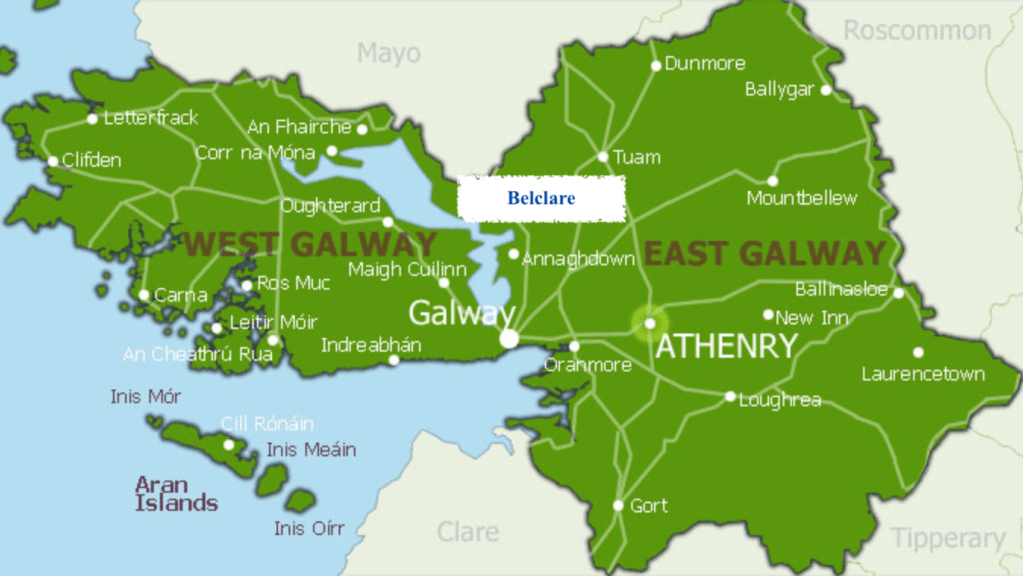
    • Lawrence Newell and Margaret Greaney, natives of Ardrumkilla, Belclare, emigrated in 1882. They are the ancestors of Matthew Jude Barker, a local history author and long-time volunteer researcher at MIHC.
    • Patrick Dorsey (Darcy/D’Arcy), a laborer from the parish of Leitrim, arrived in America via New York in 1837. He and his wife, Jane, lived on Ingraham’s Lane, off Washington and Cumberland Avenues, at the foot of Munjoy Hill. In the 1850 U.S. census, however, Patrick Dorsey, 40, is enumerated in a boarding house in the town of New Gloucester, approximately 20 miles outside the city, with 29 other men and two women, one of whom is Margaret Dorsey, 30, all of whom were born in Ireland. At this time, the Atlantic and St. Lawrence Railroad/Grand Trunk Railroad had just opened a line to the interior of the state and built a train station close to Captain Woodman’s large farm in that rural town. Patrick died in 1877, and Jane died in 1888. She left her estate, a sum total of about $700, to the new St. Joseph’s Home in the Deering neighborhood of Portland.
    • The Silk families from Annaghdown-siblings John and Bridget Silk, children of Patrick and Eleanor “Ellen” Burke-lived on Adams Street on Munjoy Hill, in the 1850s, with their mother. John, a laborer, married Hannah Walsh; Bridget married Michael Minnough of County Clare. John Silk(e), a son of Thomas and Bridget “Biddy” Ford, arrived in America in 1866 and, a few years later, married Mary Foley/Folan at St Dominic’s church. This couple lived at various addresses at the foot of Munjoy Hill. A son, Patrick Martin, became a priest, serving various Catholic communities around Maine and eventually at St Dominic’s parish. Another son, Thomas Joseph, was a General Yardmaster with the Grand Trunk Railroad and became an active local politician.
    • John Creaven (Craven), of Ballintleva, and Catherine Greally, of Belclare, were married in 1865 in Belclare. They were living in Amesbury, Massachusetts by 1867, and moved to Portland by 1875.
    • John Shaughnessy, a laborer, hailed from Gort and frequently served as a witness for mid-19th-century naturalizations.
    • Thomas McCormick, born in Gurteen ca. 1844, found work as a laborer at the Portland Rolling Mill Company.
    • Michael Skerritt of Kilgill, Annaghdown, and Bridget “Annie” Curran of the Headford area settled in the St Dominic’s church neighborhood on the west side of the city. Michael worked at the Portland Gas Company. They are the great-grandparents of Steve Luttrell, former Poet Laureate of Portland, founding editor of The Cafe Review Art & Poetry quarterly magazine, and husband of this author.
    • Ann “Nancy” Houlahan of Eyrecourt married Michael Carroll. The Carrolls settled on Cumberland Avenue with their family, and were joined by her relatives, Patrick and Michael Houlahan.
    • Patrick J. Burke of Headford married Annie E. Staunton of Mossfort, Caherlistrane, in 1885 at St. Dominic’s church.
    • Michael Burke and Bridget “Delia” Greally of Annaghdown and Belclare, respectively, married in 1857 at St. Dominic’s church in Portland. John Costello and Mary Walsh were their witnesses. Michael found work as a laborer and boiler maker with The Portland Company, and they settled on Adams Street. Their descendants include this author.
    • At the turn of the century, a trend of young single Irish women immigrated from Galway to America, and some of them found steady work as Domestic Housekeepers with wealthy families in the city. One of these women was Catherine Elizabeth Steed, born in 1868, in the townland of Glennafosha, Belclare. On her 1924 declaration to naturalize as a U.S. citizen, she reported being employed as a “lady’s maid.”

    Some East and North Galway surnames found in Greater Portland:
    Burke, Barrett, Brehaney, Carr, Carroll, Connolly, Colleran, Costello, Craven/Creaven, Cunningham, Cullinane, Curran, Delaney, Dorsey/Darcy, Fahey/Fahy, Faherty, Flaherty, Gantley, Glynn, Grealy/Greally/Greely, Grady, Hannon, Hession, Higgins, Houlahan, Joyce, Kelly, Mannion, McCormick, McLaughlin, Monaghan, Moran, Newell, Quinn, Rainey, Shaughnessy, Silk, Skerritt, Stanton/Staunton, Steede, Tiernan, Thornton, Walsh, and many more.

    Did your ancestors hail from East or North County Galway and settle in the greater Portland area? Where did they work and what type of work did they do? Drop a little note about your ancestor’s story in the comment section below.

    ♥︎ Krista

    Note: Some details of this post were extracted from a brochure that fellow researcher Matthew Jude Barker and I created for distribution at the 2016 Galway Diaspora Conference held in Galway City.

  • Peggy’s Daughters

    Many moons ago, when I first began my journey into the realm of family history, my intention was simple: to write a small book about what I had discovered, for the benefit of my beloved children and the generations who will come after them.

    In the early Spring of this year, I finally began this long-anticipated project. I’m now a few chapters in. Nearly thirty years of research, interviews, data collection, and sifting through historical information has given me plenty to unpack and organize. It’s no small task to shape it all into a structured and meaningful narrative.

    I’m not a professional writer. In fact, I’ve never written a book before. But here I am-writing one. I’m doing it with joy, and I’m not letting my lack of experience stand in the way.

    At first, I thought I would call the book Bridget’s Daughters. Bridget I. Greally, a direct ancestor from my maternal line, was born in a clachan in a small townland in North County Galway, Ireland. As a teenager, she immigrated to Portland, Maine in the wake of the Great Hunger-a calamity that devastated Ireland between 1845 and 1852. I originally intended to focus on her life and legacy.

    But I soon realized I wanted to go a bit deeper. I wanted to include not just Bridget’s story, but also that of her family-the life they lived before, during, and after she crossed the cold, vast Atlantic. That thought led me one generation further back, to Bridget’s mother, Margaret “Peggy” Reilly. By starting with Peggy, I can tell a broader story, one that includes Bridget’s known sisters and gives context to the early and mid 19th century-a time of great change and hardship in Ireland.

    Historical Context: The Great Hunger and the lives of ordinary Irish Women

    The Great Hunger (An Gorta Mór) was more than a famine; it was a profound social and political catastrophe. Caused primarily by repeated failures of the potato crops due to a fungus called Phytophthora infestans, and exacerbated by British laissez-faire economic and governmental policies, the famine wiped out approximately one million people and forced another two million or so to emigrate. More people died or left the country in its wake. This was particularly true in the western parts of Ireland, including County Galway, where my maternal line great grandmothers were born and raised.

    The period of the Great Hunger forever changed Irish society. It broke families and their communities apart, depopulated entire townlands, and fundamentally altered gender roles. Young women like Bridget may have emigrated, and some did so alone, driven by both economic necessity and mere survival.

    Emigration from East and North County Galway to places like Portland, Maine in the US, was part of a larger trend. By the mid-19th century, Portland had become a known port of entry for Irish men, women and any children they may have had, offering employment opportunities in the rapidly growing railroad industry, factories, mills, and in domestic service. Some married women like Bridget, instead, tended to the unpaid domestic duties of their own homes, and to the care and needs of their husbands and children. Bridget’s journey is just one thread woven into the great fabric of the Irish diaspora.

    I’m feeling enthusiastic about this book. But I’m not rushing. I’m letting it unfold moment by moment, writing as the story continues to reveal itself in my thoughts.

    Thank you for reading this first post on my new WordPress website. Your comments are welcomed.

    ♥︎ Krista

  • Hello

    Welcome to my new site, where I share bite-sized stories about community and family history, along with some creative arts content. Be sure to check out the about, interviews, links and talks pages, too. Please afford me some grace while I learn to create and use the site.

    The above photo is of my husband and me, taken several years ago, and we are sitting on the hag’s chair boulder, an engraved kerbstone, beside an astronomically aligned (equinox rather than solstice) passage tomb at Slieve na Calliagh, Loughcrew in Ireland.

    Thank you for your support and visiting.

    ♥︎ Krista