Happy New Year! As the United States of America celebrates its 250th birthday, I’ll be sharing 12 bite-sized stories, one per month, throughout this year to explore how Maine’s Irish community helped shape the incredible experiment in democracy we know as the United States of America.
Picture Revolutionary-era Maine with its dense, dark, primordial forests, biting Atlantic winds, and long, rugged, rocky coast. In the 1700s, Maine was still part of Massachusetts, and it bordered what would become Canada. Indigenous communities have called these lands home for thousands of years, and the tribes such as the Passamaquoddy and Penobscot still do. English settlements began dotting along the coast and rivers starting in the previous century, and some Irish were found among them.
The British Isles and Ireland experienced much unrest during the 17th century. Oliver Cromwell’s conquest of Ireland reshaped the island, and any Irish who were perceived as a threat to the British authorities may have been killed, imprisoned, or shipped off to America and sold into indenture contracts, typically for a period of seven to ten years. Some, however, arrived in the new world of their own free will, and some of them may have agreed to a contract to pay for their ship passage. In New England, including Maine communities, especially in southwestern York County, they worked in mills and on farms and as servants in the homes of local families. Once a contract was up, they could truly begin their lives.
Maine attained statehood in 1820. Until then, Maine was considered the frontier territory of the state of Massachusetts. The O’Brien and Sullivan families are among the better-known Irish families in the Maine frontier during this period. They exemplify what it means to be an American pioneer with a patriotic spirit. Maurice O’Brien left Ireland, in 1737 and joined a small but growing number of Irish settlers on the coast. He first lived in Kittery, married Mary Cain, and together they raised a large family, including several sons. The O’Brien family ultimately settled down on the opposite end of Maine, in the community of Machias, where he ran a mill. His sons, Jeremiah and John, became American Revolutionary War heroes when they captured a British ship during the Battle of Machias. Their family story will be the focus of one of my first posts in this series. James Sullivan’s family lived in the town of Berwick, Maine. His father hailed from Limerick, Ireland, and became a schoolmaster after completing his indenture. This family would throw a nod to their ancestral homeland when they named the town of Limerick, in Maine. James would go on to become a Governor and the first Irish American Governor of the state of Massachusetts.
I hope you’ll join me on this journey as I share stories about some Maine Irish Patriots who helped shape our country and state during this important time in our nation’s history.
Thank you for reading.
♥︎ Krista
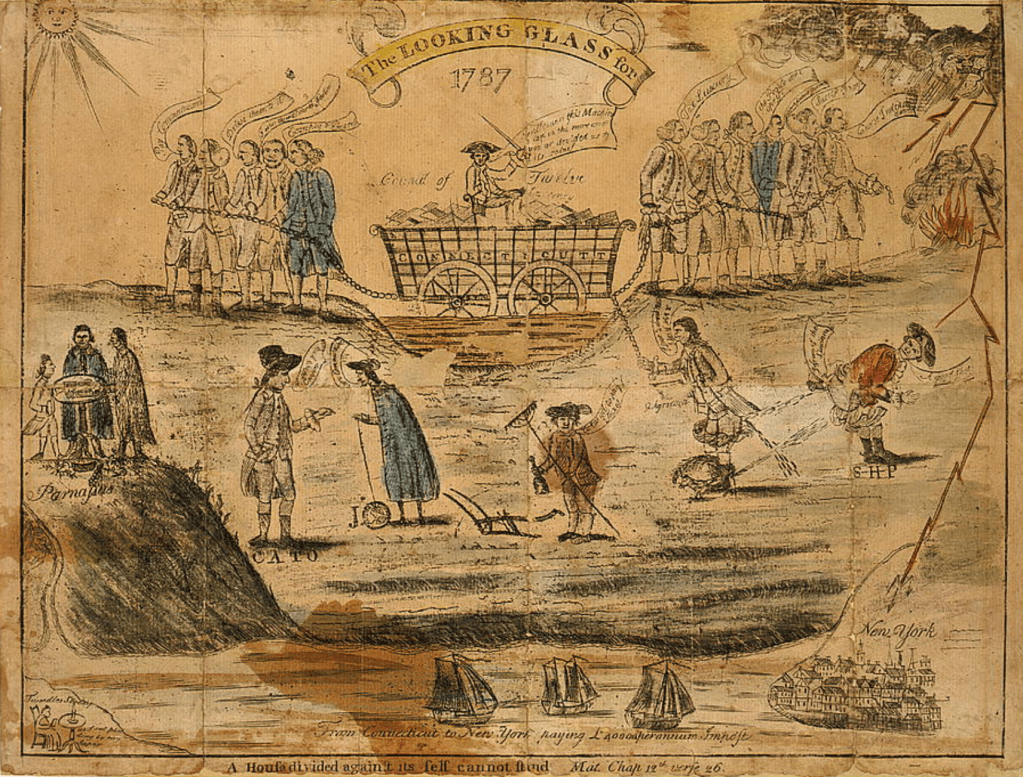
Photo: “A house divided against itself cannot stand.” Amos Doolittle (1754-1832), engraver. Library of Congress website.
 Krista Luttrell
Leave a comment