The United States of America turns 250 years old this July 4th, and even though 1776 seems like ancient history, it’s not that long ago. Maine was part of Massachusetts at the time and played a part in the American Revolutionary War. One of the most notable events in Maine was the Battle of Machias, a naval battle that made heroes out of a band of brothers: Jeremiah, Gideon, John, William, Dennis, and Joseph O’Brien.
The brothers were members of a large Maine Irish family. Historical records indicate that their father, Maurice “Morris,” was an immigrant from Cork or Dublin, Ireland, or that he was born in Dublin and sailed to America from Cork. The origin stories are conflicting; however, Y-DNA testing should be informative in this context. Maurice first lived in Kittery, where he married Mary Cain. In 1750, the family first moved to Scarborough, near Falmouth Neck (Portland). About 15 years later, they joined a migration of Scarborough families who resettled farther up the coast in the newly formed community of Machias, where they worked in the lumber industry and engaged in some marshland farming. In relation to Kittery, Machias sits on the opposite end of Maine’s jagged coastline, right along the present-day boundary of Canada, at New Brunswick and Nova Scotia. The O’Briens were counted among the names of original settlers of the town and were involved in the erection of a double saw mill that they named “Dublin Mill” in the southerly part of Machias, which was colloquially known as little “Dublin.”
At this time, grievances had grown among the Colonists towards Great Britain, and it seemed big changes were about to take place. A wonderful little description of what was ensuing is found on the history webpage for the Burnham Tavern in Machias. It states the following:
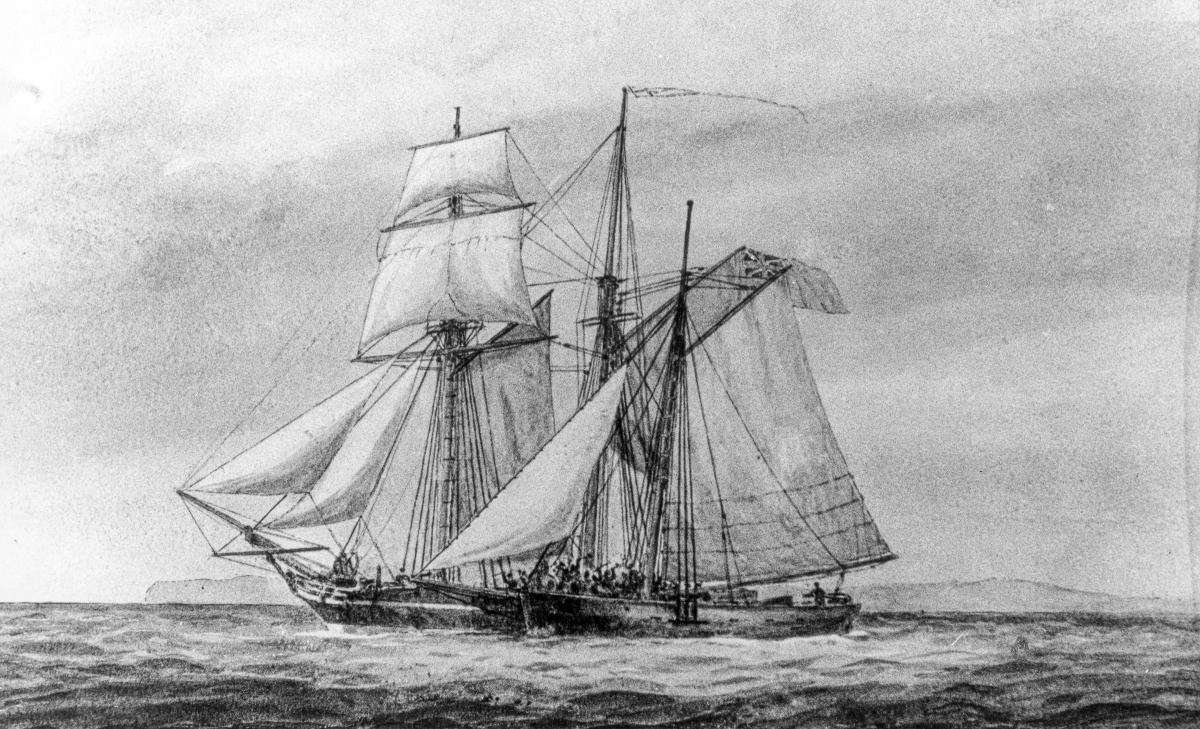
“In early June 1775, the settlement of Machias faced a critical decision amid escalating tensions. News of the conflict at Lexington and Concord reached them swiftly, followed by an ultimatum: supply lumber to Boston for British barracks or face hunger and reprisal from Midshipman James Moore and his ship, the Margaretta. “
When British ships arrived in the harbor near Machias to seize that lumber for their troops, the O’Brien brothers, led by the eldest, Jeremiah, along with several dozen local men, decided to take matters into their own hands. They rushed aboard the sloop Unity and captured the British schooner Margaretta. This event occurred around the same time as the historic attacks on Falmouth Neck and the Battle of Bunker Hill in Boston.
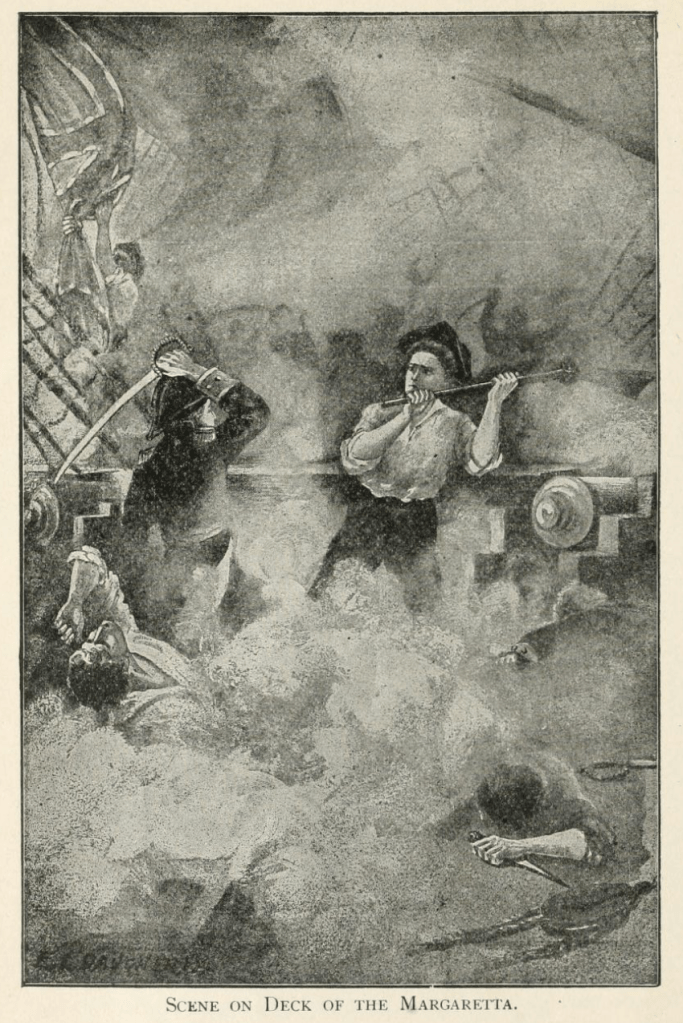
©1904 Drisko, Narrative of the Town of Machias, p 44
After that victory, Jeremiah commanded the Machias Liberty and became both the first captain and the first Irish American captain of the Massachusetts Navy. He and his brother, John, would go on to command several ships during this important war, and they would capture several enemy vessels. The British eventually seized Jeremiah and put him in a hulk, which is a prison ship, in New York Harbor, then carried him off to England. He was detained altogether for about two years. Fortunately, he managed to escape and get back home. In 1811, U.S. President James Madison appointed him as the customs collector in Machias, a position he proudly held right up until his end. He was buried with his family in the O’Brien cemetery, overlooking the water.
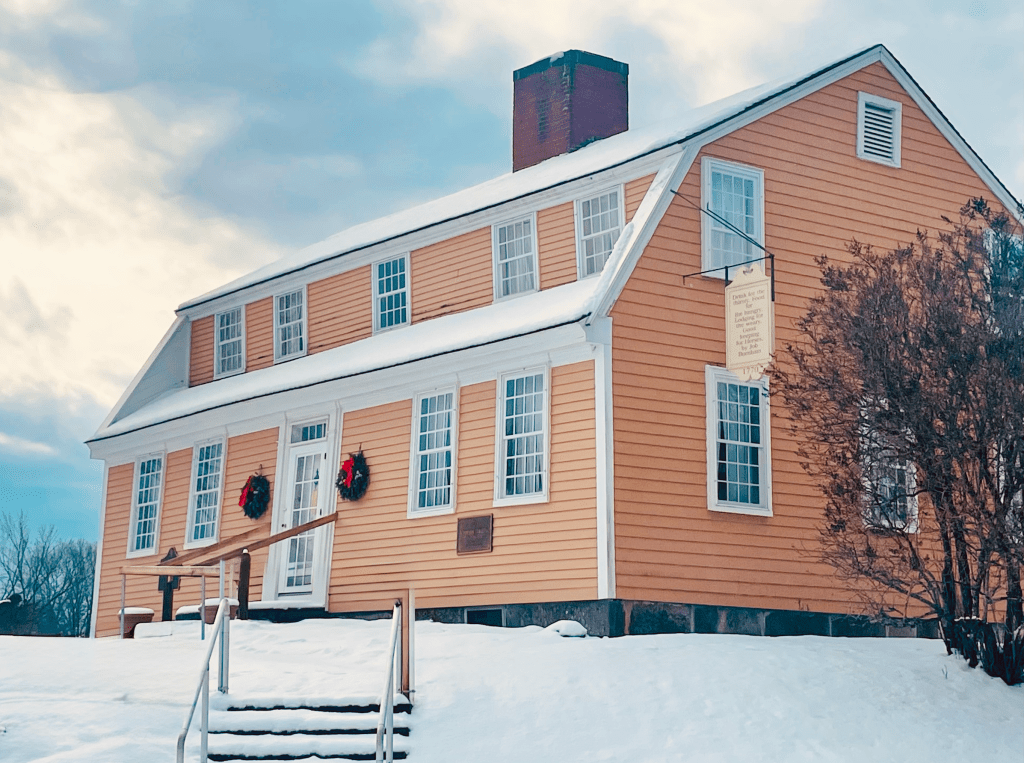
The Job Burnham Tavern, presented as the feature photo for this story, was built in 1770, only a few years before the war began. As can be seen, it still stands proudly in Machias as the place where the O’Brien brothers and other local patriots planned the strategic attack on the Margaretta. The Tavern is now a museum run by a local chapter of the Daughters of the American Revolution and houses many interesting, historically relevant artifacts, including items belonging to the O’Brien family that were used in that first naval battle.
In modern times, a bridge, a military fort, a school, a train, and several U.S. Navy battleships have been named in honor of Jeremiah O’Brien, the most recent of which was built in the mid-1970s and operated until 2004.
There is much that could be added to this story about the Battle of Machias, the Margaretta, and the O’Brien family, and their collective contributions to the fight for America’s Independence. Yet there is already so much material published that I don’t feel I’d offer anything new. If you’d like to learn more, please check out the resources I shared below or do a search online. I do, however, suggest that living descendants consider DNA testing if it has not yet been done. FamilyTreeDNA company offers three main types of tests: Y-DNA, mtDNA, and autosomal DNA. Y-DNA testing should establish Maurice O’Brien’s surname line’s place of origin, if testing hasn’t already been done by his male-line descendants. Regarding Mary Cain’s origins, Full mtDNA testing by direct-line daughter descendants may also provide insight. FamilyTreeDNA allows its testers to join projects, at no additional cost, tailored to their specific research interests, such as haplogroups, SNPs, geographical locations, family lineages, and surnames. Irish DNA, including Y-DNA testing, is very well represented in Ireland.
Disclosure: I am not a paid affiliate or paid promoter of FamilyTreeDNA or any other DNA testing company. I do, however, as a person whose DNA has been tested and who appreciates its extraordinary value, support and promote DNA testing as a powerful genealogical tool, especially for solving ancestral mysteries!
In the next short story of this series, I will share a bit about a Maine Irish Sullivan family. Stay tuned!
Thank you for reading.
♥︎ Krista
—
Sources/Further Reading
Sherman, Rev. Andrew M., Life of Captain Jeremiah O’Brien, Machias, Maine, Commander of the First American Naval Flying Squadron of the War of the Revolution. George W Sherman, 1902. archive.org/details/cu31924032737656. Last accessed January 28, 2026
Drisko, George W., Narrative of The Town of Machias, The Old And The New, The Early and Late. Press of the Republican, 1904. archive.org/details/narrativeoftowno00dris. Last accessed January 28, 2026.
Ahlin, John Howard, Maine Rubicon: Downeast Settlers during the American Revolution. Picton Press, 1966.
Official Town of Machias, Maine: machiasme.gov
Porter Memorial Library, Machias, Maine: porter.lib.me.us
Machias Historical Society, Machias, Maine and information regarding activities for celebrating the 250th: machiashistoricalsociety.com
Feature Photo: Job Burnham Tavern, est. 1770. Machias, Maine. ©2026 A. Herrman, photographer.


 Krista Luttrell
Leave a reply to Amanda Cancel reply